
What’s the Difference, Bet? There is some sophisticated terminology used in the real estate industry, the most prevalent of which being ‘RK’ and ‘BHK.’ What are these phrases, and how do they apply to today’s homebuyers? This is one of the questions this blog seeks to answer.
You might be wondering what the difference is between an RK and a BHK in Indian real estate.
Understanding their meaning is critical for buyers and developers since they emphasize aspects such as a property’s layout and overall size, price range, functionality, and buyer suitability. This will allow you to make better-educated decisions based on your lifestyle, budget, and space requirements, thereby matching the property to your demands as an occupant and improving living comfort and pleasure.
What is 1 RK in real estate?
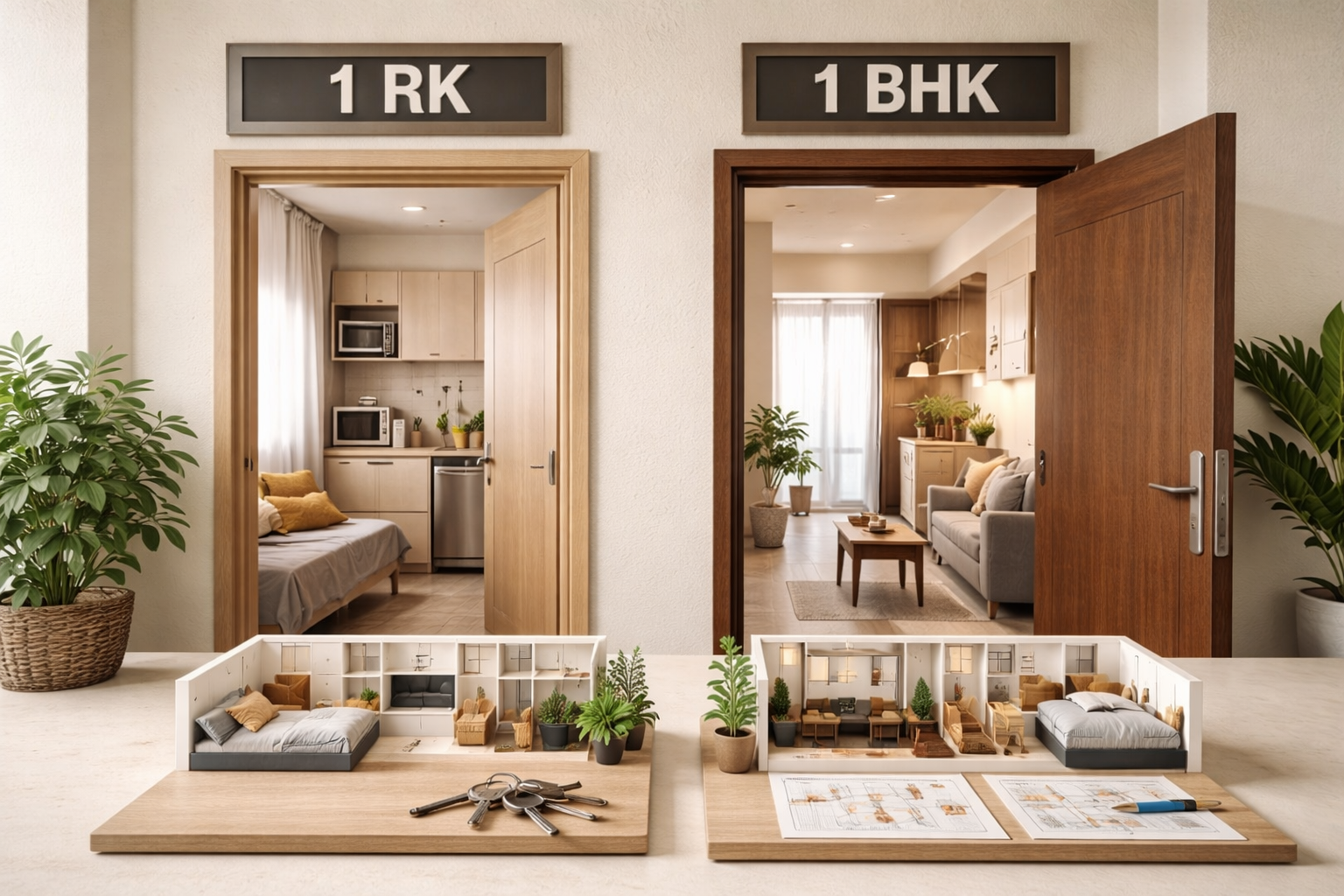
The full version of 1RK is “1 Room Kitchen.” This refers to a flat that comprises largely of one room with a separate kitchen. The single room functions as a bedroom, dining area, and hallway. An RK’s plan allows the occupant to make the most of the available space, and it is popular in urban locations where space and the opportunity to own a large home are scarce. While it may be cramped, the area may be made comfortable with proper organization and setup.
What does 1 BHK mean in real estate?
BHK is a higher-level real estate arrangement, with the initials standing for Bedroom-Hall-Kitchen. This is perhaps one of the most often used and essential terms in real estate, and you’ve almost certainly seen it on apartment listings. You’re undoubtedly asking, “1 BHK means how many rooms in a home?” When you hear variations like 1, 2, or 3 BHK, it signifies that the house has one, two, or three bedrooms, as well as one hall (the living room) and a kitchen.
Differences Between RK and BHK.
Understanding the fundamental differences between RK and BHK is crucial since it will help you learn more about residential spaces and how they operate. What’s the difference between RK and BHK in Indian real estate?
|
Feature |
BHK |
RK |
|
Rooms |
Has a living room, bedroom, and kitchen |
A single room and one kitchen |
|
Space |
Has more space |
Compact |
|
Cost |
Higher costs |
Affordable with lower utility costs. |
|
Furniture Placement |
More options for furniture placements |
Lesser space for furniture |
|
Living Room |
Separate from the bedroom |
Combined with the bedroom |
|
Kitchen |
Separate |
Combined with the living room or bedroom. |
What Layout Do Indians Prefer?
The answer depends on the city where they live. People frequently prefer different apartment layouts based on the available space in the state they live in. The decision is heavily influenced by socioeconomic factors and cultural norms. Let’s investigate this:
RK Layout:
As previously said, RK apartment units are fairly widespread and becoming popular in dense urban areas. With the number of young working professionals in major areas continuously increasing year after year, RK apartment units provide an efficient and economical dwelling space. Young people who relocate to these areas for work possibilities are frequently affected by the property’s location and price, generally prioritizing this over comfort and additional room. This explains why the pattern is popular in densely populated areas like Mumbai and Bangalore.
BHK Layout:
This layout is more popular in places like Chennai and Delhi because to variables such as lower population density and affordable housing options, which allow residents to invest in larger living spaces. Cities like Chennai and Delhi have cultures that are more akin to family living conditions, which cannot be met by RK apartment units alone. Because Mumbai and Bangalore are always drawing younger working folks looking for job prospects, they are less inclined to choose larger BHK options because they are less expensive.
Legal considerations
The decision to buy or rent an RK or BHK property is frequently governed by a variety of rules and norms designed to safeguard the interests of both owners and tenants, as well as purchasers and sellers.
Take, for example, the Real Estate Registration and Development Act. It was founded in 2016 to promote transparency, accountability, and efficiency in the real estate industry. It also obliged developers to register their projects and give all relevant information to consumers.
Rental agreements are also subject to state-specific rules, such as the Model Tenancy Act 2021. It enacted rent control legislation as well as rules governing security deposits, eviction notices, and maintenance. It also helps manage common processes for lease or purchase agreements, payment terms, duration, and termination circumstances. This promoted fair dealings and safeguarded the interests of all parties concerned.
Advantages and disadvantages of RK and BHK units.
RK Units:
Pros
Living space is compact and multifunctional.
Affordable, making it appealing to young professionals and students.
Lower your utility bills.
Frequent passengers demand easier maintenance.
Urban areas offer convenient access to jobs, leisure, and public transportation.
Cons
The lack of separate rooms can reduce privacy.
Lack of space.
It is unsuitable for all lifestyles.
Fewer storage possibilities.
There is no flexibility in design.
BHK Units:
Pros
BHK apartment design include one or more bedrooms, a living room (hall), and a kitchen, meeting diverse living demands.
Having separate bedrooms provides privacy.
The space is in high demand from families and those wishing to share a house with a roommate.
More space equals more comfort.
Cons
Higher costs
The higher the area, the more rent you must pay.
Additional utility bills.
Less supply, and frequently located far from city centers.
Less appropriate if you have a limited budget.
Target Audience:
RK Units.
Students, bachelors, and young professionals prefer them since they are economical and tiny, making them suitable for their lifestyles.
BHK Units:
Suitable for families, couples, or people looking for a well defined living space. Separate bedrooms also provide extra privacy.
Lifestyle considerations:
While an RK is suitable for people who prefer compact living with essential utilities and spend less time at home, a BHK is ideal for families that desire comfort and space, as well as a house close to their workplace, schools, hospitals, and places for relaxation and socialization.
Pricing and affordability
RK Units:
A one-room-kitchen home is typically selected by budget-conscious buyers or tenants since it is less expensive to maintain and use. Additionally, residents save money on furniture.
BHK Units:
Although the prices are greater, the living conditions are better. There is increased comfort due to privacy and location, as well as additional conveniences. The high rent and maintenance costs are justified because they ensure a higher quality of life.
Investment and Resale Value
RK Units:
RK flats have a lower value potential because to their low demand and small size. They may be less expensive, but have no market value. Short-term renters have minimal investment potential.
BHK Units:
BHK flats, such as those offered by Rustomjee, appreciate more, particularly in urban and suburban locations. The size and amenities generate more demand, which leads to a higher resale value. A well-located BHK home can also provide a significant return on investment, making it an excellent choice for long-term investing.
Rental Income:
RKs have lower rental income because of their small spaces and renters are typically students or bachelors. There is a higher turnover rate and shorter lease terms. A BHK, on the other hand, draws families and working professionals, resulting in longer rental agreements and consistent rental yields. Furthermore, the location might increase demand and improve rental returns.
Conclusion
To summarize, the decision between an RK and BHK home is based on your demands and preferences. A one-room kitchen is more cost-effective and space-efficient for those who require less space, making it a popular choice among bachelors and students. BHK apartments are in high demand due to its privacy, space, and comfort, which appeal to families, roommates, and those who desire separate living and sleeping rooms despite their high cost.
So, whatever you choose, be sure it meets your needs as a resident. After all, your comfort is very important!
FAQs
- What does “RK” stand for in Indian real estate?
RK stands for ‘Room-Kitchen,’ which refers to a small unit with a single room that doubles as a bedroom and has an adjacent kitchen.
- What does “BHK” stand for in Indian real estate?
BHK is an abbreviation for Bedroom-Hall-Kitchen. Residents get a separate bedroom, a common area, and a kitchen.
- How do RK apartments differ from BHK apartments?
An RK apartment consists of a single space that serves as both a living room and a bedroom. In contrast, a BHK contains a separate bedroom, living space, and kitchen, providing inhabitants with solitude.
- What is best for families: RK or BHK?
A BHK home is excellent for families since it gives separate living, sleeping, and kitchen areas for each member, ensuring privacy and comfort.
- What are the benefits of choosing a BHK over an RK?
A BHK provides additional space, privacy, higher resale value, higher rental demand, and suitable for long-term living.
- How does RK’s resale value compare to BHK apartments?
BHK flats have a better resale value due to increased demand, whereas RK units have limited possibilities for appreciation and resale.
- What’s the difference in size between RK and BHK units?
RK units are typically 200 to 400 square feet (applicable to Mumbai), whereas BHK apartments range from 400 to 700 square feet (relevant to Mumbai), depending on location, style, and developer.
- How many square feet is one BHK?
It normally ranges from 400 to 700 square feet (in Mumbai). These figures may differ based on the builders and the city.
- How many square feet is one RK?
It typically ranges from 200 to 400 square feet (in Mumbai); however, this might vary based on the layout and location.