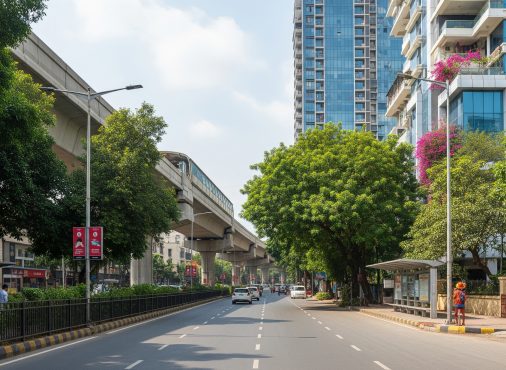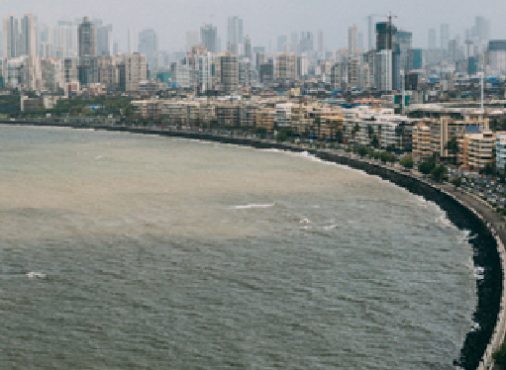


Mumbai is in the middle of an infrastructure reset that’s rewriting the city’s real estate map. New and upgraded transport links led by the Mumbai Trans Harbour Link (MTHL), the Sewri-Worli elevated connector, and the Coastal Road are shortening commutes, opening growth corridors, and shifting buyer demand from a handful of island-city enclaves into formerly overlooked pockets such as Sewri, Wadala, and other parts of Navi Mumbai.
As these projects redefine how the city moves, they’re simultaneously redrawing the investment landscape, making connectivity the single most powerful driver of property value in 2026.
Understanding Infrastructure’s Direct Impact on Property Values
Infrastructure is one of the most powerful and consistent drivers of real estate value in Mumbai, and its impact can be understood through a few simple, repeatable mechanisms:
- Time-savings premium: When new links shorten commutes and make travel more reliable, buyers are willing to pay more to buy flats in Mumbai that help them reclaim precious hours each day.
- Location advantage & value capture: Every new road, bridge, or transit line increases footfall and commercial potential in surrounding neighbourhoods. Mumbai’s infrastructure boom is driving property prices up to 23% in well-connected corridors such as those near the Coastal Road, MTHL, new metro lines, and the upcoming international airport in Navi Mumbai.
- Economic agglomeration & secondary development: Improved access attracts offices, warehousing, logistics hubs, and new business districts. They create employment hubs that further boost residential demand, which is a reinforcing cycle often referred to as infrastructure-led growth.
- Rental Yield Enhancement: Professionals prefer to live closer to new mobility hubs. Rentals near metro stations, expressways, and sea-link access points command higher yields. After Phase 2 of Metro Line 3 (BKC–Worli) opened, some nearby localities saw rent increases: Mahim by 2.37%, Sion by 1.78%, Dadar by 1.47%, Worli by 1.32% and Prabhadevi by 1.06% within a month of the metro’s operation.
Mumbai Trans Harbour Link: Gateway to Eastern Suburb Growth
The 21.8 km MTHL (Atal Setu) physically links Sewri (south Mumbai) to Chirle/Nhava Sheva (Navi Mumbai), turning what used to be a two-hour cross-harbor journey into a 20-25 minute drive for many routes. That dramatic travel-time reduction instantly repositions Sewri/Wadala as a gateway neighbourhood to Navi Mumbai.
- Sewri is now a logical place for buyers who want fast access to Navi Mumbai and JNPT/Nhava Sheva.
- Projects with direct or privileged MTHL access can command a location-advantage premium relative to the wider neighbourhood.
Sewri-Worli Elevated Connector: The Missing Link
The planned 4.5-km Sewri-Worli elevated corridor creates the physical tie between the MTHL and the western-coast expressway network (Bandra-Worli Sea Link / Coastal Road). Designed to provide signal-free east-west movement, the connector is expected to carry a significant part of MTHL traffic.
Evidently, the shift in real estate Mumbai is measurable: average ticket sizes in the Mumbai Metropolitan Region rose from about ₹1.02 crore in early-2021 to roughly ₹1.57 crore in early-2025 (a ~54% increase), and institutional capital has flowed back into the city.
Bandra-Worli Sea Link and Western Suburbs Premium
The Bandra-Worli Sea Link has long been a structural price-differentiator for Bandra West and nearby western suburbs. Combined with the Western Express Highway and strong local rail links, sea-link access underpins the premium location and premium pricing of sea-facing and high-amenity products, a dynamic reflected in high-end launches (4/5-BHK apartments, penthouses) that command substantial per-sq-ft premiums.
Bandra West remains a blue-chip luxury market because of this aggregated connectivity advantage.
Read Also: Sewri – The New Address of Luxury
Mumbai Metro Expansion: Reshaping Commuter Patterns
Metro corridors, notably Line 3 (Colaba-BKC-SEEPZ), Line 5 (Thane-Bhiwandi-Kalyan), and Line 9 (Dahisar-Mira Bhayandar), are expanding the city’s high-capacity public-transport footprint. Metro Line 3 is expected to drive 10–15% property appreciation in Bandra, Khar, and South Mumbai once the line is fully operational.
Markets like Andheri, Ghatkopar, Dahisar, Thane, and BKC–SEEPZ corridors have outpaced adjoining areas due to walk-to-transit convenience.
Coastal Road Project: Accelerating Western Corridor Development
Mumbai’s 29.2-km Coastal Road from Marine Drive to Bhayandar is rapidly transforming mobility along the western coastline. The operational Marine Drive-Worli stretch has already delivered major time savings. Routes that previously took up to two hours now often take under an hour, with some segments dropping from 40 minutes to 9-12 minutes.
As Phase 2 and key interchanges advance, the project is tightening access across Bandra, Juhu, Worli, and Versova. This improved connectivity is driving 5-15% property appreciation, particularly in premium, sea-facing, and high-rise segments, as demand rises in western-suburb micro-markets benefiting from faster coast-to-coast movement.
Investment Momentum: Institutional Confidence in Infrastructure Markets
Mumbai’s infrastructure upgrades have triggered a strong comeback of institutional capital. The city attracted ~USD 1.2 billion in institutional real estate investments in the first nine months of 2025, with a significant share coming from foreign investors, particularly the US and Japan.
Much of this capital is targeting connectivity-led micro-markets strengthened by projects like MTHL, Coastal Road, and the expanding Metro network.
- Signals long-term confidence: Institutions generally invest only when infrastructure-led appreciation is considered durable and multi-cycle.
- Improves market stability: Large, patient capital reduces volatility in commercial and residential asset classes.
- Improves liquidity: High-quality projects near major infrastructure nodes see faster leasing, refinancing, and exit options.
- Encourages premium development: Strong capital flow enables developers to launch larger, better-spec’d projects aligned with rising end-user demand.
Read Also: How Infrastructure Growth is Boosting Real Estate in Dombivli
Rustomjee Sewri and Rustomjee Cliff: Developer Quality and Infrastructure Advantage
Rustomjee’s portfolio exemplifies how strong developer credibility combined with strategic, infrastructure-aligned locations can significantly enhance long-term real estate value.
Rustomjee Sewri
- Direct access to the Mumbai Trans Harbour Link (MTHL), the Sewri-Worli Connector, and the Eastern Freeway makes commuting significantly faster.
- Designed for modern living with 2, 3, and 4-BHK apartments, lush landscaped open spaces, 24/7 security, and premium amenities.
- Located in a rapidly transforming precinct, giving potential for strong 5.9% capital appreciation as infrastructure projects mature.
Rustomjee Cliff Tower
- An exclusive landmark in Bandra West-Mount Mary area, offering only 37 ultra-premium residences (4/5/6 BHK).
- Offers breathtaking 270° sea views of the Arabian Sea and Bandra skyline, thanks to its elevated position.
- Rich lifestyle amenities: rooftop infinity pool, club lounge, landscaped gardens, wellness zones, and 24×7 security.
Conclusion
Mumbai’s 2026 real estate cycle is being reshaped not by sentiment, but by hard infrastructure like MTHL, the Sewri-Worli Connector, Metro expansion, and the Coastal Road, compressing commute times, redistributing demand, and pushing micro-market values upward in a measurable way. Locations aligned with these corridors are already outperforming, and the next 18-24 months will likely deepen this divergence.
Projects like Rustomjee Sewri and Rustomjee Cliff Tower benefit from the Coastal Road’s western corridor uplift. Step inside for a private site experience and see why these addresses are becoming the benchmark for elevated living.
FAQs
- How do infrastructure projects increase property values in Mumbai?
Infrastructure shortens travel times, raises footfall, and retail and commercial activity. It therefore increases willingness-to-pay and developer interest.
- Which Mumbai localities will benefit most from MTHL and the Sewri-Worli Connector?
Sewri and Wadala are immediate beneficiaries of the MTHL (connecting South Mumbai to Navi Mumbai). Prabhadevi and Worli gain materially from the Sewri-Worli elevated connector’s signal-free east-west link.
- Should I invest in areas where infrastructure projects are under construction or completed?
If you seek higher upside and accept timing or schedule risk, early entries into under-construction corridors can deliver larger gains. On the other hand, completed projects offer lower upside but faster liquidity and clearer pricing.
- What role does Mumbai Metro expansion play in residential property demand?
New metro corridors expand high-capacity public transit, cut commute times, and create transit-oriented demand. Station-proximate markets consistently outperform adjacent areas in absorption and price growth.
- How can NRI investors capitalize on Mumbai’s infrastructure-led real estate growth?
NRIs can target infrastructure-adjacent micro-markets like station or interchange catchments and MTHL or Coastal Road corridors, prioritize MahaRERA-registered projects and reputable developers, or access institutional vehicles/REITs that are increasing allocations to Mumbai.