
Every year, people from all walks of life relocate to Mumbai in search of better opportunities. The city of dreams has unparalleled travel connections, thanks to its great highways and Mumbai Metro. The Mumbai Metro Line 3 is the latest addition to the city’s rapidly expanding metro network. It is also known as the Mumbai Metro Aqua Line and the Colaba-Bandra-SEEPZ Line.
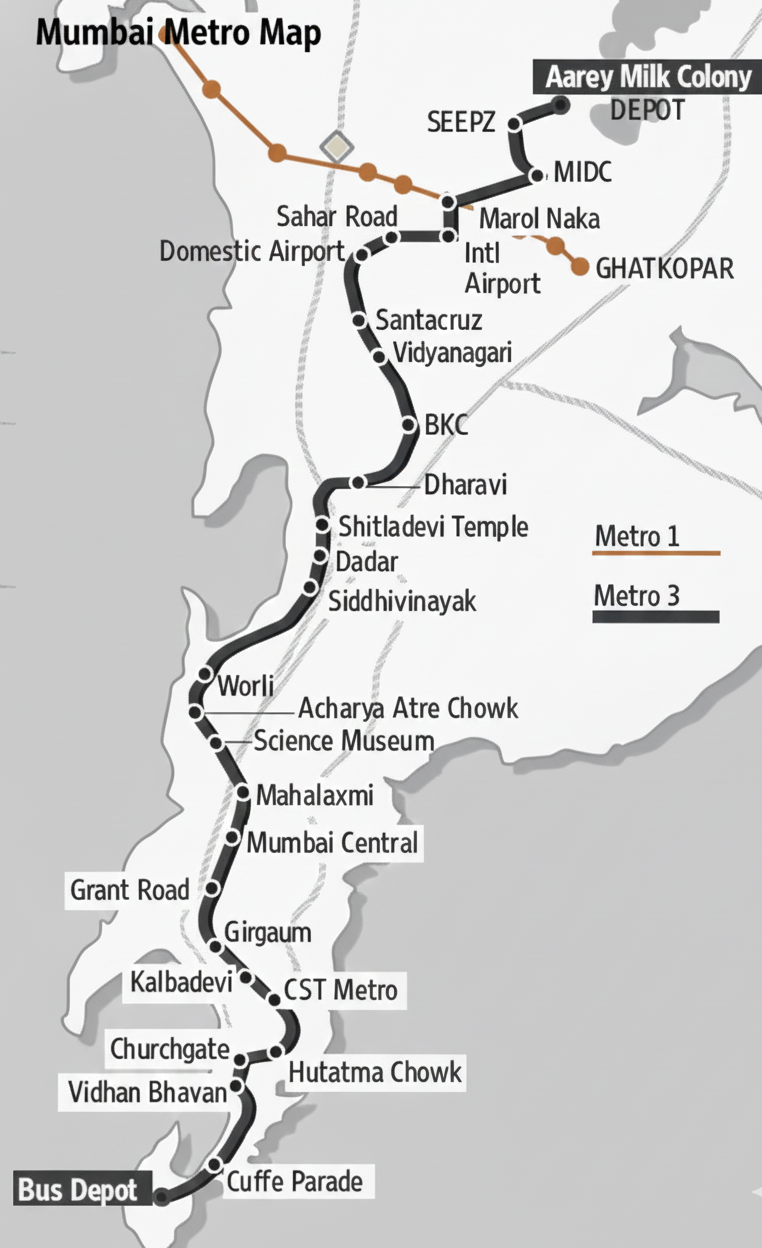
Metro Line 3 is 33.5 km long and includes 27 stops from Cuffe Parade to Aarey Colony. The metro line is scheduled to be operational in three phases. The Bandra Kurla Complex (BKC) to Aarey Mumbai route went live on October 7, 2024. The Mumbai Metro Line 3’s second phase, which runs from BKC Metro Station to Worli (Acharya Atre Chowk), opened on May 10, 2025. The third segment of Mumbai Metro Line went operating on 08 October 2025.
Mumbai Metro route 3 will be operated by the MMRC (Mumbai Metro Rail Corporation Limited) and would largely be an underground route. The project was launched as a 50:50 joint venture between the GOI (Government of India) and the GOM (Government of Maharashtra).
JICA (Japan International Cooperation Agency) is financing the majority of the project (57.2%) with an ODA loan of Rs. 13,235 crores with a 30-year repayment period, a 1.15% interest rate for project operations, and a 0.01% interest rate for consulting services.
Mumbai Metro Line 3 Inauguration
The entire Mumbai Metro Line 3, or Aqua Line, is now completely operational. On October 8, 2025, Prime Minister Narendra Modi formally opened the final stretch of the queue. This event marks a significant milestone for Mumbai’s transport network. This final portion of the line is referred to as Phase 2B. The path runs from Worli to Cuffe Parade. With its opening, the entire 33.5-kilometer line is ready for public usage.
Mumbai Metro Line 3 Key Facts
|
Name of Mumbai Metro Line 3 |
Aqua Line |
|
Estimated Cost |
Rs 37,000 cr. (approx) |
|
Total Length |
33.5 km |
|
Type |
Underground and At-Grade |
|
Number of Stations |
27 |
|
Estimated Ridership |
17 Lakhs per day |
|
Status |
Became fully operational on 8 Oct 2025 |
Mumbai Metro Line 3 Route Map: The Underground Metro Mumbai Route
The Mumbai Metro Line 3 is intended to make commuting easier for passengers. It is the city’s first totally subterranean metro line, with 26 of 27 underground stations.
Mumbai Metro 3 Stations
The following is a list of stations on Mumbai Metro Line 3, which runs from Aarey Colony to Cuffe Parade and includes both elevated and underground metro Mumbai routes.
| S. No | Mumbai Metro Line 3 Station | Station Layout | Opening Date |
|
1 |
Aarey Colony | At-Grade |
October 2024 |
|
2 |
SEEPZ | Underground |
October 2024 |
|
3 |
MIDC | Underground |
October 2024 |
|
4 |
Marol Naka | Underground |
October 2024 |
|
5 |
CSMIA T2 | Underground |
October 2024 |
|
6 |
Sahar Road | Underground |
October 2024 |
|
7 |
CSMIA T1 | Underground |
October 2024 |
|
8 |
Santacruz | Underground |
October 2024 |
|
9 |
Vidyanagri | Underground | October 2024 |
|
10 |
BKC (Bandra Kurla Complex) | Underground | October 2024 |
|
11 |
Dharavi | Underground |
May 2025 |
|
12 |
Shitladevi Temple | Underground |
May 2025 |
|
13 |
Dadar | Underground | May 2025 |
| 14 | Siddhivinayak Temple | Underground |
May 2025 |
|
15 |
Worli | Underground |
May 2025 |
|
16 |
Acharya Atrey Chowk | Underground | May 2025 |
|
17 |
Science Museum | Underground | October 2025 |
|
18 |
Mahalaxmi | Underground |
October 2025 |
|
19 |
Mumbai Central | Underground |
October 2025 |
|
20 |
Grant Road | Underground |
October 2025 |
|
21 |
Girgaon | Underground |
October 2025 |
|
22 |
Kalbadevi | Underground |
October 2025 |
|
23 |
Chhatrapati Shivaji Maharaj Terminus | Underground |
October 2025 |
|
24 |
Hutatma Chowk | Underground |
October 2025 |
|
25 |
Churchgate | Underground |
October 2025 |
|
26 |
Vidhan Bhavan | Underground |
October 2025 |
|
27 |
Cuffe Parade | Underground |
October 2025 |
Mumbai Metro Line 3 Current Status
It is also known as the Aqua Line Metro Mumbai and will be launched in phases. This is the city’s first subterranean metro.
Operational Routes
- Aarey to BKC Metro Station
Started: October 7, 2024
Length: Around 13 km
Stations on this route: Aarey, SEEPZ, MIDC, Marol Naka, Airport T2, Sahar Road, Airport T1, Santacruz, Bandra Colony, BKC
- BKC to Worli (Acharya Atre Chowk)
Opened: May 10, 2025
Length: Around 10 km
Stations included: Dharavi, Shitladevi Temple, Dadar, Siddhivinayak Temple, Worli, Acharya Atre Chowk
- Worli to Cuffe Parade
Opened: October 08, 2025
Route includes: Science Museum, Mahalaxmi, Grant Road, Girgaon, Kalbadevi, CSMT, Hutatma Chowk, Churchgate, Vidhan Bhavan, and ends at Cuffe Parade.
The last phase of the Mumbai Metro Line 3 has been postponed. It was formerly set for September 30, 2025, but has been postponed. The new expected date of opening is October 8, 2025.
According to sources, Prime Minister Narendra Modi inaugurated the Mumbai Metro Line 3 portion connecting Worli and Cuffe Parade to the rest of the nation. The following are the key facts about the project.
Final Phase: The third and final segment of the line is a 9.5-kilometer subterranean route that connects Acharya Atre Chowk (Worli) and Cuffe Parade. It contains eleven stations.
Total Route: The 33.5-kilometer subterranean tunnel connects Cuffe Parade in South Mumbai to Aarey in the North.
The metro route serves 1.6 million passengers every day. It significantly reduces the travel time between northern and southern Mumbai. Furthermore, it reduces pressure on the city’s suburban rail network and congested highways. It also provides critical connectivity to the city’s local and international airports.
Interchange stations of the Mumbai Metro Aqua Line
The Aqua Line Metro Mumbai itinerary map includes multiple interchange stations that connect commuters to other metro lines or trains. This includes:
The SEEPZ (Santacruz Electronic Export Processing Zone) station links to Line 6 of the Mumbai Metro.
The Churchgate Metro Station connects commuters to the Western Line (Mumbai Suburban Railway).
Marol Naka Metro Station connects to the Mumbai Metro Blue Line 1.
Mumbai Central metro stations connect with the National Rail Network and the Western line (Mumbai Suburban Railway).
The CSMIA T2 (Chhatrapati Shivaji Maharaj International Airport, Terminal 2) Metro station links to the Mumbai Metro Red Line 7.
The Mahalaxmi metro station is also connected to the Western Line (Mumbai Suburban Railway) and the Mumbai Monorail.
The CSMT metro station links to three different lines. It includes the National Rail Network, as well as the Mumbai Suburban Railway’s Central and Harbour Lines.
The Marol Naka metro station connects to Mumbai Metro Line 1.
The BKC (Bandra Kurla Complex) metro station links to Mumbai Metro Line 2.
Aqua Line Metro Mumbai Fare
Mumbai Metro 3 fares range from Rs.10 to Rs.50 per route. Please find detailed fare information below.
| Distance in Km | Single Journey Ticket |
|
0 to 3 Km |
Rs.10 |
|
3 to 12 Km |
Rs.20 |
|
12 to 18 Km |
Rs.30 |
|
18 to 24 Km |
Rs.40 |
|
24 Km & More |
Rs.50 |
Metro Line 3 Mumbai offers a 25% fare discount for differently abled passengers.
MMRCL has now implemented a 25% fare concession for differently abled passengers. This rule is effective as of November 23, 2025. The overall goal is to make the metro more accessible and convenient for persons who require additional assistance.
Here are the main points:
The discount applies only to passengers with disabilities.
It is available with MetroConnect-3 app trip passes.
Currently, this feature only works on the iOS version.
The Android version is still delayed, as it requires Google’s clearance.
Once the update is complete, a 25% discount on monthly passes will begin.
MMRCL said this is part of their effort to make travel more inclusive.
NCMC Tap-and-Travel Card: Mumbai Metro Line 3
The Rupay National Common Mobility Card has been launched for the Mumbai Metro Line 3. MMRC (Mumbai Metro Rail Corporation Limited) launched the card on June 9, 2025, in collaboration with State Bank of India and National Payments Corporation of India.
Commuters can use the NCMC metro card’s quick tap-and-travel feature. The metro card is valid at all operating Mumbai Metro Line 3 stations, from Aarey JVLR to Acharya Atre Chowk. Commuters on Line 3 of the Mumbai Metro can pay a cashless fare using the NCMC metro card.
NCMC Metro Cards are exclusively available for use on Metro Line 3. These cards are available for purchase at any approved State Bank of India branch and at any Mumbai Metro Line 3 metro station’s ticket counter. NCMC Metro Cards are distributed for free, with an obligatory first top-up of Rs.100.
WhatsApp Ticketing: Mumbai Metro Line 3
Mumbai’s vital Metro Line 3 (the Aqua Line) has launched a very easy ticketing system. All you need to do is utilise WhatsApp. This feature is available to passengers on the line that runs between Cuffe Parade and Aarey JVLR. Riders can now acquire QR-based tickets quickly without having to download a separate mobile app. The primary goal is to make travel easier, faster, and more efficient for all. Commuters can quickly avoid large lineups at traditional ticket desks, saving important time. This service also benefits the environment by eliminating the usage of printed paper tickets, supporting sustainable and green mobility across the city. The service allows users to purchase up to six tickets in one transaction. It also accepts a variety of payment options, including UPI payments, which incur no additional fees.
Here are the simple procedures to purchase your metro ticket using WhatsApp:
|
Step |
How to Begin |
What To Do Next |
|
1 |
Send a message on the official number- +91 9873016836. A simple ‘Hi’ would get you in the chat box. |
Or scan the QR code available at the metro station. |
| 2 | Select your starting and ending stations. |
Choose the number of tickets you wish to obtain. You can only choose up to 6 at once. |
|
3 |
Make the payment. |
Select your payment option such as UPI. |
|
4 |
Receive your QR ticket instantly on WhatsApp |
Scan this QR ticket at the metro entry gate. |
Mumbai Metro Line 3 Timings
Find the metro train times for the Mumbai Metro 3 or the Aqua Line Metro Mumbai.
|
Days |
Timings |
|
Monday to Saturday |
06:30 AM to 10:30 PM |
|
Sunday |
08:30 AM to 10:30 PM |
Infrastructure of Mumbai Metro Line 3
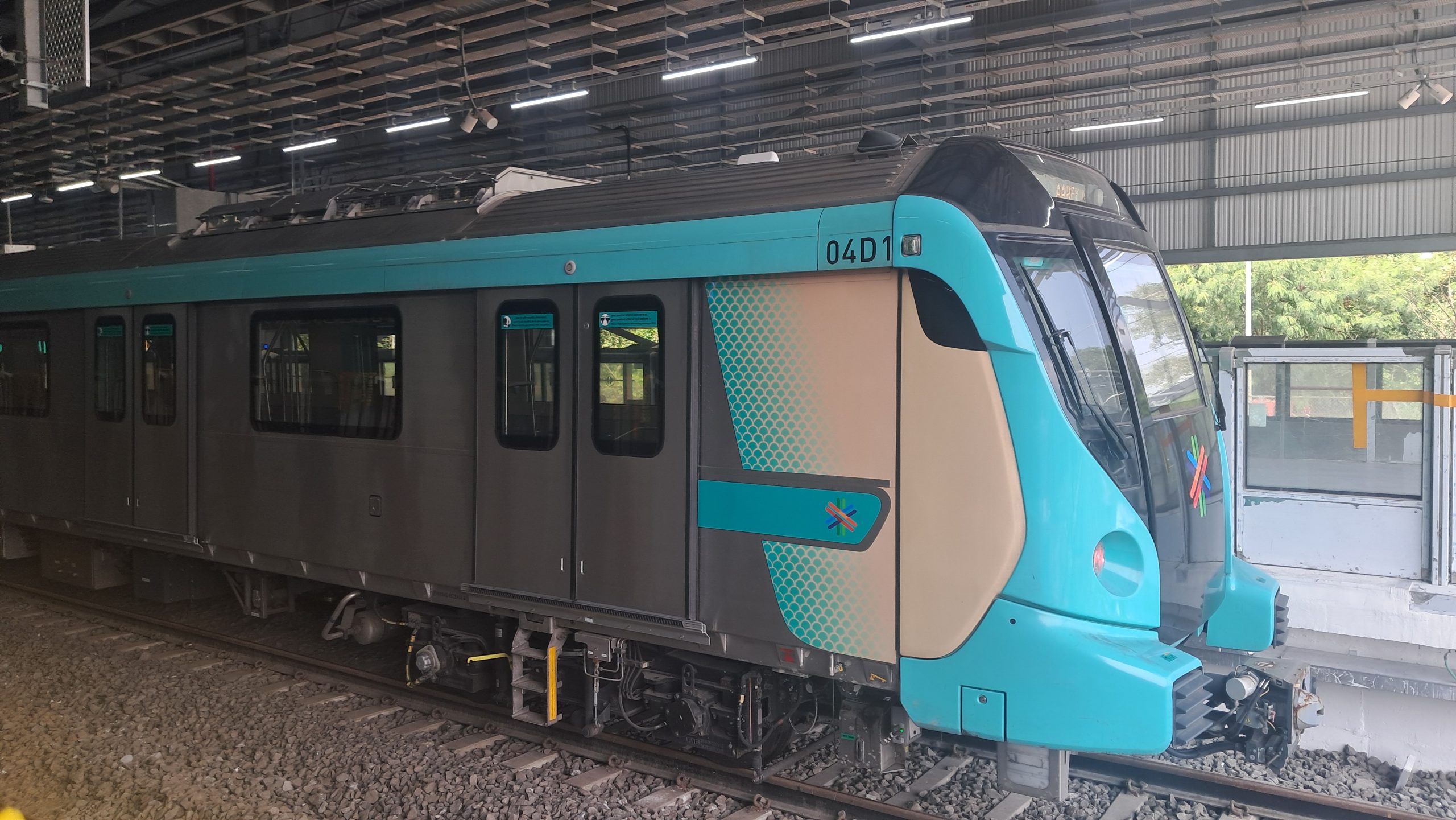
In September 2018, the MMRC awarded a EUR 315 million contract to Alstom Transport (a French transportation company) and its Indian affiliate to supply 336 coaches for Mumbai’s Colaba-Bandra-SEEPZ Line. According to the deal, the agency is in charge of the train sets’ production, design, supply, installation, and testing. Each coach seats around 300 passengers, giving the trains a total seating capacity of 3,000 passengers.
Interestingly, Mumbai Metro Line 3 has a Grade 4 automation level, indicating that it is driverless. However, during its first year of operation, MMRC hired drivers. Mumbai’s Metro Line 3 employs the Alstom Urbalis 400 CBTC (Communications-Based Train Control) signalling system.
Mumbai Metro Line 3 Expansion
The Mumbai Metro Rail Corporation has planned to expand the Mumbai Metro Line 3 route to Navy Nagar in Colaba, Mumbai. It will be a five-kilometer span. The announcement of the expansion was made in November 2023. The project is still pending permission from both the state and national governments. The Detailed Project Report for the Metro Stretch has been submitted to the appropriate authorities.
The officials added that the initiative to design the development of this metro line was taken to improve metro connectivity to the Navy Office in Mumbai.
Pedestrian Infrastructure to Improve Mumbai Metro Line 3 Connectivity.
Various authorised officials from MMRDA, MMRCL, Indian Railways, and BMC have agreed to create an integrated pedestrian infrastructure. The initiative was taken to make it easier for Mumbai Metro Line 3 commuters to stroll from metro stations to their target locations. The authorities are investigating how areas around Mumbai Metro Line 3 stations might be interconnected to give seamless connectivity to commuters. This infrastructure will include pedestrian subways, footbridges, and so on.
MetroConnect3 Mobile App
Mumbai Metro Rail Corporation Limited has introduced MetroConnect3, a customised metro mobile app for Mumbai Metro Line 3. Users can install the app from their preferred app store. They may use the mobile app to browse Mumbai Metro Line 3 routes, book online metro tickets, view station amenities, and find must-see attractions near their preferred metro station.
The mobile software supports multiple languages, including English, Hindi, and Marathi, making it accessible to all commuters.
Features of Aqua Line Metro Mumbai
Find a few major features of the Aqua Line Metro Mumbai.
Managed by DMRC and MMRC: DMRC has been awarded a 10-year contract for Mumbai Metro’s Line 3, which runs from Colaba to SEEPZ.
DMRC oversees the day-to-day operations of the subterranean line. Its responsibilities include train operations and maintenance, system infrastructure, and passenger safety.
MMRC is creating the queue and is in charge of revenue management, non-fare box revenue generating, and regulatory compliance.
Emergency Doors At Both Ends: The Mumbai Metro Line 3 includes emergency doors at both ends. The emergency doors at both ends allow passengers to evacuate securely in an emergency. Such metro trains are ideal for underground parts.
Driverless Operations: Mumbai’s first underground metro line was supposed to obtain safety approval before beginning driverless operations after Phase 1 (Bandra Kurla Complex to Aarey) opened. A six-month trial is required to obtain CMRS authorisation for driverless operations. Once allowed, MMRC will transition to driverless operations.
Exceptional Capacity: The Mumbai Metro’s Line 3 trains can carry up to 3,000 passengers at a time. It is built for PHPDT (Peak Hour Peak Direction Traffic), which carries around 72,000 passengers.
CBTC signalling system: All trains are fully air-conditioned and equipped with a CBTC (Communication-Based Train Control) signalling system that allows for driverless operation.
Mumbai Metro Line 3 – Advanced Technology Details
Metro Line 3 features cutting-edge global technology. It is an extremely safe and efficient system.
Train Control System: The line employs Communication-Based Train Control (CBTC) technology. This innovative system enables trains to communicate with the control room continually. It contributes to maintaining a precise and safe gap between trains. This increases the queue capacity.
Automation: The trains run at a high level of automation. They are capable of running without a driver (driverless technology). This automation allows the service to function on time and avoids human error.
Rakes: The line employs specialized, lightweight train sets, These are referred to as Alstom rakes. They include special features such as regenerative braking. This allows the trains to generate less heat and use less energy.
Free Wi-Fi services at Mumbai Metro Line 3 stations
The Mumbai Metro Rail Corporation has offered free Wi-Fi facilities at all Mumbai Metro Line 3 (Aqua Line) stations to improve the commuter experience and provide digital transaction support.
This move was expressly launched to address the issue of poor or non-existent mobile network connectivity within the underground tunnel. It made it easy for commuters to purchase internet tickets.
|
Feature |
Detail |
|
Availability |
All 27 stations on the Mumbai Metro Line 3 (Aqua Line) |
|
Location |
Concourse (ticketing) level of every station |
|
Access Name/Network Name |
MetroConnect3 |
|
Type of Service |
Free, secure, and reliable |
Step-by-Step Guide to Connect to the Free Wi-Fi
The free Wi-Fi service is linked to the official Metro app, and you must follow the instructions to unlock full internet access.
Download and Login: Download the official ‘MetroConnect3’ mobile phone app. Before accessing the station, log in or sign into the application.
Connect to the Network: Navigate to your device’s Wi-Fi Settings. Select ‘MetroConnect3’ from the list of accessible Wi-Fi networks.
Activate Free Internet Access: Launch the ‘MetroConnect3’ software again. Go to the ‘Profile’ area of the app. To activate your free internet access, tap the ‘Connect to Wi-Fi’ option.
After completing these procedures, you will be connected to the free Wi-Fi network, allowing for quick digital ticketing and concourse-level surfing.
Mumbai Metro Line 3: Sneak Peek at Upcoming Stations
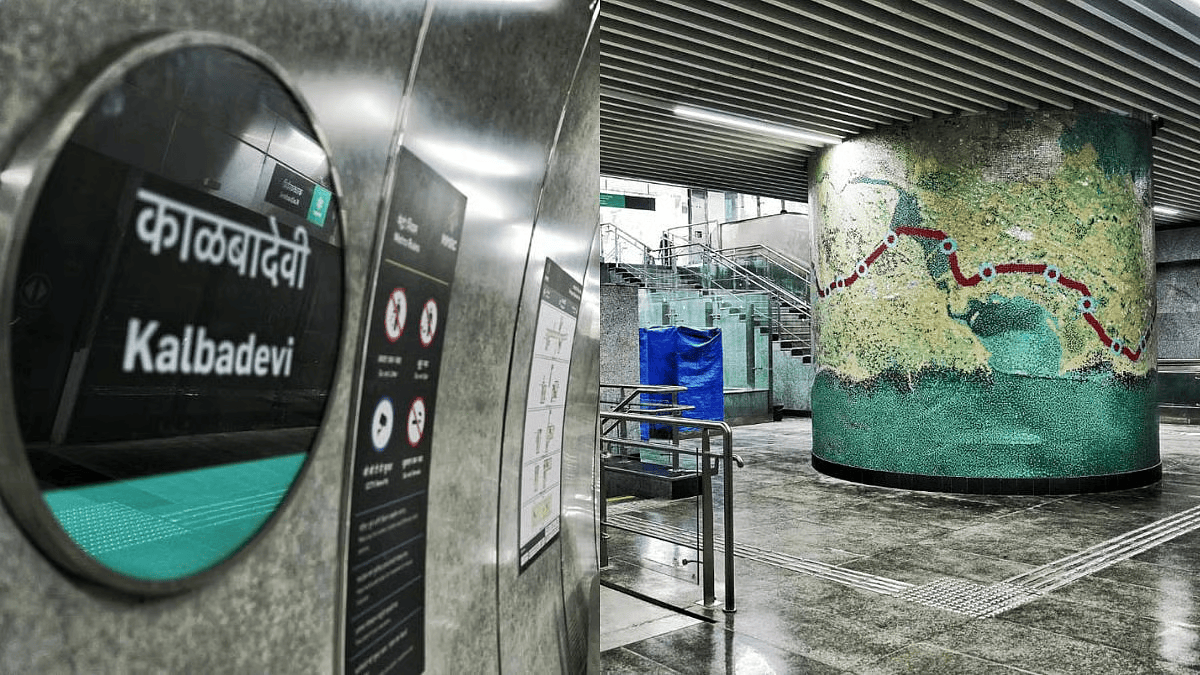
The MMRC has just released the first look at the Kalbadevi Metro Station and others at the X handle on September 29, 2025. Kalbadevi Metro Station is located in the middle of a historic commercial district. The design team performed an excellent job. They combined modern technologies with the local Marathi culture and heritage. The design was created utilising a particular approach known as the NATM method.
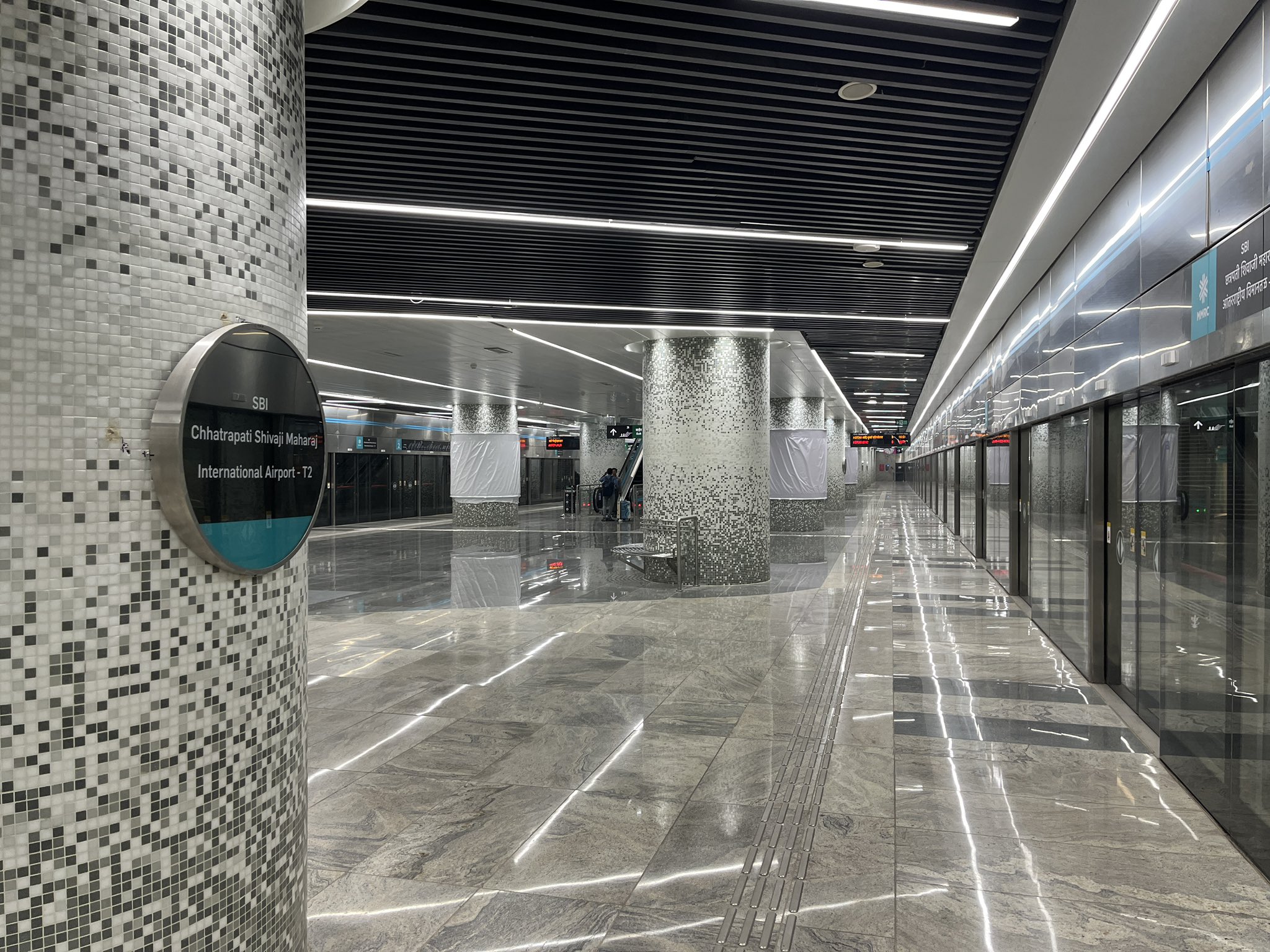
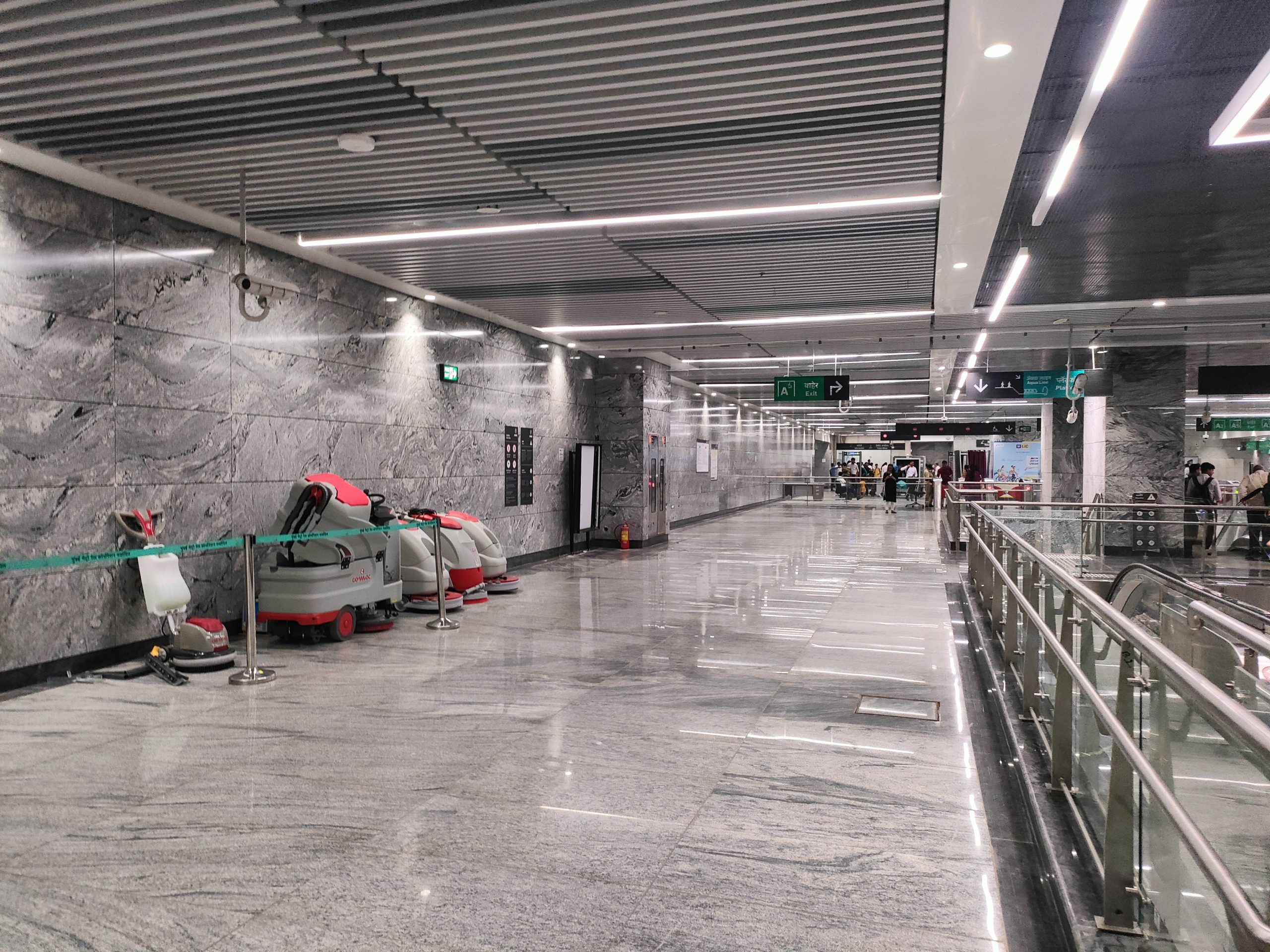
The stations of Mumbai Metro Line 3 are highly contemporary. They are designed to manage massive crowds. The signs are clearly written in three languages: English, Hindi, and Marathi. Additionally, multiple escalators and lifts have been installed for easy access.
Kalbadevi Metro Station
Chhatrapati Shivaji Maharaj Terminus Metro Station
Churchgate Metro Station
How One Woman Made Mumbai Metro Line 3 a Reality
Ashwini Bhide, the Managing Director of the Mumbai Metro Corporation, is driving work on Mumbai Metro Line 3. It was her clear vision and steady touch that made this endeavour a reality. Working through tough terrain, severe storms, and numerous delays, she led her crew with calm strength and focus.
Her leadership contributed to the resolution of significant on-the-ground issues, such as safely constructing large tunnels and managing operations without disturbing the city above. Every stage required meticulous planning and coordination, which Bhide ensured went hand in hand.
The Aqua Line currently stands as a testament to her efforts and the hard labour of hundreds of others who believed in the concept. It demonstrates how patience, expertise, and one woman’s conviction in development can transform the way Mumbai moves every day.
Mumbai Metro Line 3 Digital Monthly Pass
Mumbai Metro Rail Authority recently introduced a Digital Monthly Pass option for Mumbai Metro Line 3. With this pass, commuters will be able to enjoy sound travel on the Mumbai Metro’s Aqua line while saving money. The pass makes it the first metro in India to provide this solely through a mobile application.
The pass is valid for 30 days from the purchase date or until all of the included trips are completed, whichever comes first. Here are the main details of the newly introduced Mumbai Metro Line 3 digital monthly passes:
Digital Passes & Discounts
The monthly passes are trip-based and provide a significant discount over purchasing single route tickets:
| Pass Type | Discount on Total Fare |
|
60-Trip Pass |
15% |
| 45-Trip Pass |
10% |
How Mumbai Metro’s Aqua Line Digital Pass Works
According to officials, the passes are only available through the MetroConnect3 mobile application, which can be downloaded on both Android and iOS devices. The purchasing process is outlined below.
Download and register for the MetroConnect3 app.
Choose your origin (beginning station) and destination (ending station).
Select your desired pass (45 or 60-trip).
Make the payment using a digital means such as UPI or a card.
Once purchased and activated in the app, the pass is accessed via a QR code on your phone. This allows for seamless, contactless admission and exit at the station gates.
Impact of Mumbai Metro Line 3 on Real Estate
The Colaba-Bandra-SEEPZ Line is intended to change Mumbai’s real estate landscape. Since construction on Aqua Line 3 began in 2017, numerous developers have expressed interest in projects along its corridors.
The initial phase of Mumbai Metro Line 3’s inauguration, which occurred in October 2024, is expected to assist a variety of micro marketplaces. This covers the CBD (Central Business District), SBD (Secondary Business District), and the North, West, and Eastern suburbs.
According to analysts, once the Aqua Line is operating, the values of residential properties in Navi Mumbai and Thane will rise. It will considerably increase connectivity to the commercial hubs of SBD North and West.
Localities to Invest in Near Mumbai Metro 3
Mumbai Metro Line 3 serves the north and south of Mumbai and links to other metro lines in the city. Let’s have a look at the property prices in the areas covered by this metro line:
|
S.no |
Particulars | Property price for sale | Rent |
|
1. |
Santa Cruz East | INR 18,800- INR 30,500 per sq ft |
INR 56- INR 90 per sq ft |
|
2. |
Mahalaxmi | INR 31,800- INR 54,800 per sq ft |
INR 82- INR 132 per sq ft |
|
3. |
Worli | INR 35,400- INR 60,300 per sq ft |
INR 105- INR 189 per sq ft |
|
4. |
Cuffe Parde | INR 43,100- INR 67,700 per sq ft |
INR 123- INR 194 per sq ft |
| 5. | Mumbai Central | Approx INR 5 crore |
INR 20,000-25,000 |
MMRC Approval Required for Any Work Within 50 Meters of Mumbai Metro Line 3.
A new upgrade has been announced for buildings and land along the Metro Line 3 corridor. According to MMRC, any property within 50 metres on both sides of the Aqua Line must obtain approval before beginning redevelopment, reconstruction, demolition, excavation, or any other comparable work. This law would preserve the 33-kilometer section of underground tunnels between Cuffe Parade and Aarey.
The public notice was issued on November 30, 2025. It requires all owners, societies, and developers in this zone to obtain approval from the MMRC’s planning and real estate departments. The cause for this is the growing number of redevelopment plans in older portions of the city. Heavy machinery and extensive excavating might be dangerous if done near the metro path, therefore the agency wants to keep a watchful eye.
Here are the main features of the new rules:
Any construction or demolition work within 50 meters of the Aqua Line requires MMRC clearance.
Developers must take precautions to protect surrounding areas and people.
Regular inspections of construction tools and machinery are essential.
The primary goal is to prevent tunnel damage and accidents near the worksite.
Developers have also shown an increased interest in the districts surrounding the Aqua Line. Many builders have contacted the MMRC regarding redevelopment restrictions and FSI possibilities under the TOD policy. This demonstrates how quickly local real estate ideas are changing along the underground route.
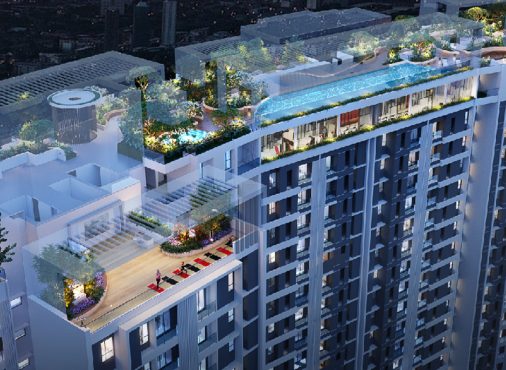
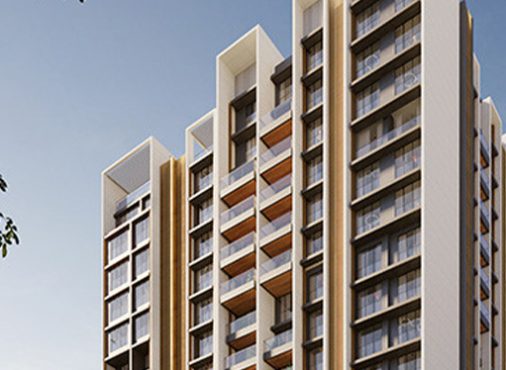
Featured Rustomjee Properties in BKC
1. Rustomjee Cleon | The Smart Urban Choice
Designed for the modern professional, Cleon offers an exclusive lifestyle in a sleek 22-storey tower.
Highlight: Strategic 2 BHK homes that offer a “hop, skip, and jump” commute to the BKC business hub.
Vibe: Vibrant, efficient, and perfect for those who want to be in the middle of the action.
2. Rustomjee Seasons | The Ultimate Gated Community
Spread over 3.8 acres, Seasons is where luxury meets leisure. It’s one of the few places in Mumbai where you can enjoy a “forest walk” within your own backyard.
Highlight: Ready-to-move-in 3 BHK residences with over 20+ lifestyle amenities including a mini-theatre and spa.
Connectivity: Just minutes away from the Western Express Highway and the new Aqua Line.
3. Rustomjee Prive | The Pinnacle of Privacy
For those who value exclusivity above all else, Prive offers a limited-edition living experience.
Highlight: Only two residences per floor, ensuring complete privacy and panoramic views from expansive sundecks.
The Edge: Ultra-luxury 3 BHK homes located just 500 meters from the upcoming metro connectivity.
Why BKC is Mumbai’s “15-Minute City”
Living at a Rustomjee property in BKC means you are part of a self-sufficient ecosystem.
Summing up: Mumbai Metro Line 3
Aqua Line Metro Mumbai (Line 3), like the other Mumbai Metro lines, is designed to increase city connectivity and reduce passenger journey time. It connects the southern parts of Mumbai to the western suburbs via an underground corridor. Now that it is complete, it removes roughly 7 lakh automobiles from the road, alleviating tremendous congestion and traffic in the city.