
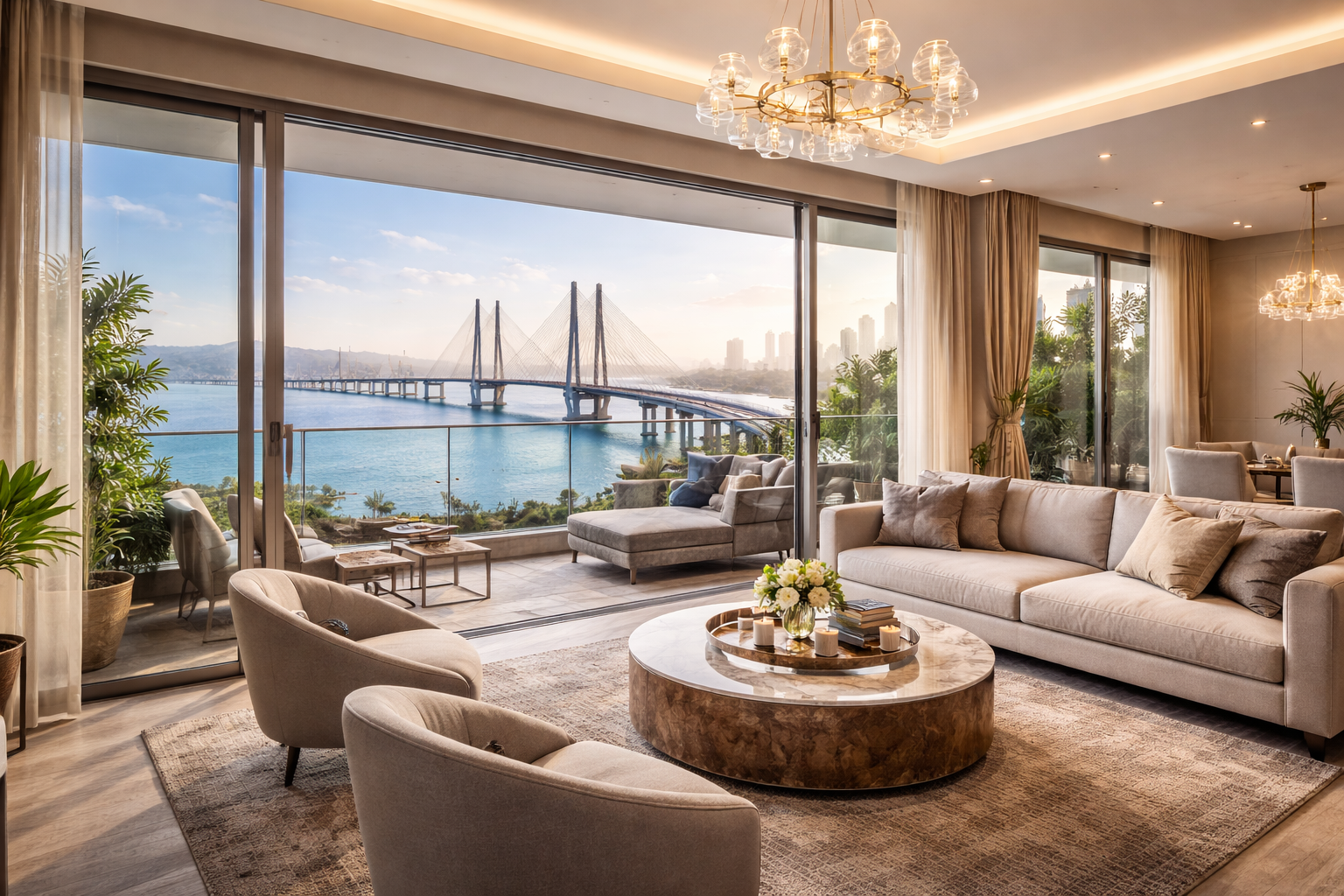
Sewri is tip-toeing from an industrial, port-side precinct to one of South Mumbai’s most compelling residential bets. Once known mainly for docks, oil tanks, and salt pans, Sewri now sits at the point where three city-shaping transport projects converge: the Mumbai Trans Harbour Link (Atal Setu), the Sewri-Worli Elevated Connector, and a growing metro network.
All these Sewri connectivity factors bring a massive developmental scope for a project like Rustomjee Sewri. These infrastructure upgrades translate into faster commutes, stronger price performance, tangible lifestyle perks, and serious NRI appeal.
Mumbai Trans Harbour Link (Atal Setu): India’s Longest Sea Bridge Redefines Sewri’s Accessibility
The Mumbai Trans Harbour Link (officially Atal Bihari Vajpayee Sewri-Nhava Sheva Atal Setu) is a 21.8 km, six-lane expressway that connects Sewri to Navi Mumbai across Thane Creek. The new sea link slashes the Sewri-Chirle/Nhava Sheva journey to roughly 20 minutes instead of the previous 60-90 minutes, opening direct, fast access to the upcoming Navi Mumbai International Airport, Jawaharlal Nehru Port (Nhava Sheva), and the Mumbai-Pune Expressway.
For residents at Rustomjee Sewri, airport runs, port-side jobs, and western-suburb commutes are suddenly practical and doable daily with Sewri connectivity.
Sewri-Worli Elevated Connector: The Missing Link Between East and West Mumbai
The Sewri-Worli Elevated Connector is a planned 4.5 km elevated corridor that will plug the MTHL into the Bandra-Worli Sea Link and the Coastal Road, providing signal-free east-to-west movement across the island. The project is designed as a traffic dispersal and east-west lifeline.
Once completed and opened in late December 2025, it is forecast to cut travel between the east coast and Worli/BKC dramatically, with estimates ranging from under 20 minutes to around 40 minutes for western suburbs, depending on origin/destination and route integration. The connector will also feed a cloverleaf interchange and ramps at Sewri to link the MTHL, Eastern Freeway, and city roads.
For Rustomjee Sewri buyers, the Sewri-Worli link turns a once one-directional commute into a true multimodal, multi-axis network.
Read Also: Why Sewri is Mumbai’s Next Big Residential Hub: Development & Growth Analysis
Mumbai Metro Line 4 Extension: Rapid Transit Coming to Sewri’s Doorstep
Beyond roads, improved rail connectivity is arriving with Mumbai Metro Line 4 (the Wadala-Kasarvadavli corridor, part of the Green Line family), which includes planned interchange nodes that integrate with Wadala and central business points and will tie into Metro Line 3 (Colaba–BKC–SEEPZ) and other lines.
A planned Sewri station as part of area planning will add rapid transit options so residents can mix sea-link driving with metro commutes for fast, congestion-free trips to CSMT, Wadala, and BKC. This converts Sewri into a genuine multimodal transit hub rather than a car-dependent pocket.
Eastern Freeway & Harbour Line: Established Connectivity Networks Serving Sewri Today
Properties in Sewri already benefit from established transport networks of the Eastern Freeway, providing fast road access eastwards (MMRDA signal-free connectors now shave additional minutes to BKC). Sewri Railway Station on the Harbour Line gives frequent, low-cost rail links to CST, Thane, and Panvel, with many Harbour trains stopping at Sewri, reaching CSMT in about 10-15 minutes.
Add the nearby Ambedkar Nagar monorail, and you have immediate, layered access to the island city. In other words, Sewri’s new projects build on a functional base rather than inventing connectivity from scratch.
Read Also: Sewri: The Hidden Gem of Mumbai’s Real Estate
Real Estate Impact: Property Value Appreciation Driven by Infrastructure Development
Sewri is moving from opportunistic to the mainstream premium market. Rates of flats in Sewri average in the INR 44,500 per sq ft band and point to a +5.9% year-on-year appreciation in areas tied to infrastructure deliveries.
When you compare this with entrenched luxury nodes such as Worli or Lower Parel, Sewri offers a strong infrastructure-led value proposition. It has near-comparable amenity and sea-view potential, but at a lower price point today and with outsized upside as connectivity projects open.
Lifestyle Benefits: How Connectivity Transforms Daily Living for Sewri Residents
Enhanced connectivity is reshaping everyday life for residents of Sewri, making the city feel smaller, faster, and more accessible than ever before.
With Atal Setu, the Sewri-Worli Connector, and upcoming Metro links, long commutes shrink into short, predictable journeys. This transformation translates into a smarter work-life balance, quicker airport access, and a lifestyle enriched by effortless movement across Mumbai.
- Airport Access: The BOM Airport is 20 minutes from Navi Mumbai via Atal Setu. Residents also get quicker access to the existing Mumbai airport via the internal road network, which is good for frequent flyers and NRIs.
- Healthcare Access: Residents benefit from faster connectivity to top-tier medical institutions such as Tata Memorial, KEM Hospital, Global Hospital (Parel), and Breach Candy Hospital.
- Education Convenience: Improved road and metro links give families quicker access to leading schools and colleges like Don Bosco, St. Paul’s, Bombay Scottish, Podar International, St. Xavier’s College, and newer IB institutions in BKC and Lower Parel.
- Weekend Escapes: It is easy to access the Panvel/Mumbai-Pune Expressway and the Konkan coast and rush for weekend getaways like Alibaugh and Lonavala quickly. Residents can escape to Worli Sea Face, Haji Ali, Marine Drive, NMACC, and Mahalaxmi Racecourse without taking long, circuitous routes.
Comparative Advantage: Sewri vs Traditional Mumbai Luxury Markets
Sewri is quietly becoming Mumbai’s smartest luxury alternative, and the timing couldn’t be better. While traditional hotspots like Worli, Lower Parel and BKC still dominate the spotlight, Sewri is carving out its own competitive positioning with something they can’t match: multi-direction connectivity.
With the Sewri–Worli Connector and the MTHL reshaping east-west-south movement, you can zip to Worli, reach BKC quickly, or head straight to Navi Mumbai and the new airport without the usual city drama. Plus, you get premium-grade projects from top developers at prices that sit comfortably below Worli and Lower Parel’s steep ₹/sqft brackets, a seriously attractive value proposition for luxury buyers who want more without overspending.
Add future-ready infrastructure, modern amenities, sea views, and the promise of long-term appreciation, and Sewri suddenly feels less like a “new entrant” and more like a smart, strategic upgrade for homebuyers who want luxury with logic.
Environmental & Sustainability Considerations: Balancing Development with Sewri’s Natural Heritage
The transformation comes with environmental responsibility.
MMRDA’s planning for MTHL and related projects explicitly includes noise barriers, vision barriers, and ‘silent zone’ stretches around the Sewri mudflats, which is a crucial flamingo habitat. The mitigations during construction with silenced machinery, restricted work periods, and monitoring put a limit on disturbance.
Development in Sewri is thus being balanced with conservation measures; builders such as Rustomjee also highlight sustainable construction practices in their precincts to reduce project footprints. Protecting the mudflats while enabling connectivity is a central part of the area’s long-term liveability equation.
Conclusion
If you are considering Sewri, whether as an owner who wants sea views with practical commutes, an NRI seeking airport-friendly access, or an investor chasing infrastructure-led returns, now is the time to act. Rustomjee Sewri sits at the center of this transformation: close enough to reap benefits today and well placed to capture upside as the Sewri-Worli Connector and metro layers finish rolling out.
Ready to experience Sewri’s new era of connectivity and premium living? Explore Rustomjee Sewri today and secure your place at the heart of Mumbai’s most promising transformation.
FAQs
- How has the Mumbai Trans Harbour Link reduced travel time from Sewri to Navi Mumbai?
MTHL has cut Sewri-Navi Mumbai travel from 1.5-2 hours to roughly 20-25 minutes due to its 21.8 km signal-free sea link. It also provides the fastest access to NMIA, JNPT, and the Mumbai-Pune Expressway.
- What is the completion timeline for the Sewri-Worli Elevated Connector, and how will it benefit residents?
The connector is ~57% complete and is targeted for a December 2025 opening. It will provide a 10-minute east-west link between Sewri and Worli, bypassing traffic bottlenecks.
- Which metro lines will serve Sewri, and when are they expected to become operational?
Metro Line 4 (Wadala-Kasarvadavli) is 84.5% complete, with trial runs expected soon. Passenger operations are projected to start by end-2025, improving rapid-transit access for Sewri.
- What makes Rustomjee Sewri’s location strategically advantageous for daily commuters?
It sits at the convergence of MTHL, the upcoming Sewri-Worli Connector, and Metro 4. This gives residents fast multi-directional access to BKC, Worli, Lower Parel, and Navi Mumbai.
- Can NRI buyers benefit from improved connectivity when investing in Sewri properties?
Yes, NRI buyers benefit from improved connectivity when investing in Sewri properties. The MTHL gives direct access to the upcoming Navi Mumbai International Airport. This makes Sewri ideal for frequent flyers seeking better travel efficiency and rental demand.