

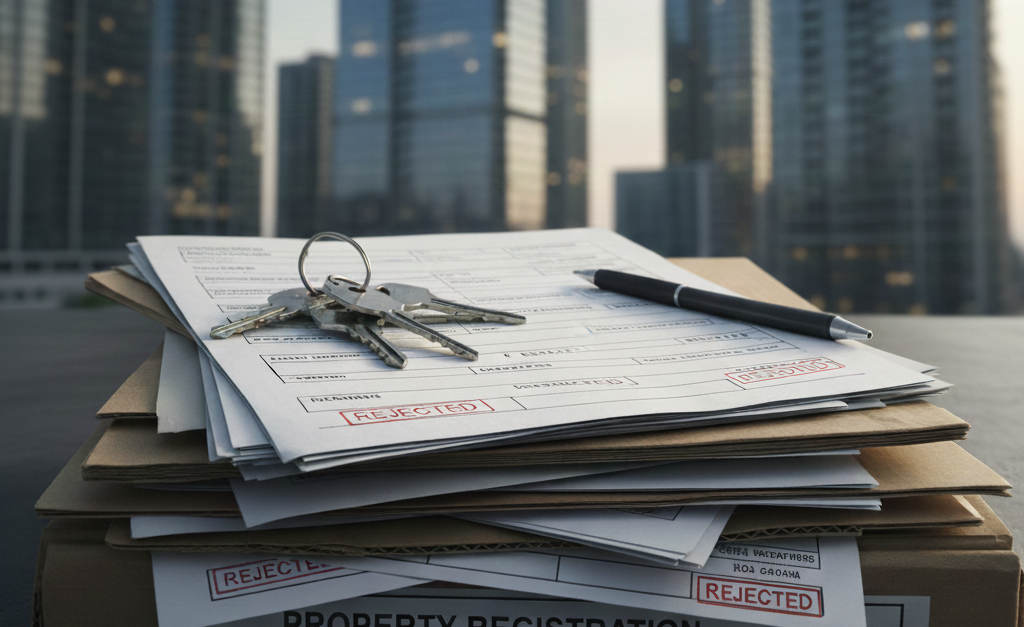
After a property sale or transfer, the owner must fulfill a legal obligation: register the property. According to Section 17 of the Registration Act, 1908, property registration is a legal procedure in which property documents, such as the sale deed, must be registered with the local government authority. It gives the transaction legal validity, and the registered document serves as proof of ownership, thereby preventing property disputes. Buyers must carefully complete the property registration process. Any mistake on the buyer’s part or errors in the details recorded by officials can create problems, including ownership issues, legal complications, and penalties. However, the government provides a facility for rectifying such errors. In this guide, we discuss the common mistakes to avoid during the property registration process.
#1. Not verifying the title and ownership history
One of the first stages in buying a home is to ensure that the property has a good title. A clean title indicates that the property is free of liens, claims, and ownership conflicts. There will be no difficulty transferring ownership of such a property through a sale or another way. Many property buyers fail to verify the title and ownership history of properties, resulting in legal complications. Some of the issues that a buyer may encounter as a result of failing to check the property title include:
Legal problems with other parties about property ownership
Difficulty obtaining home loans, including rejection of loan applications.
Property-related frauds that cause financial losses or legal hassles
Difficulty selling the property due to a lack of title clarity.
Noncompliance with government regulations (in the absence of appropriate documentation)
Buyers must review the mother deed, which is a record of the property’s entire ownership history. An encumbrance certificate is another important land ownership document. In addition, buyers must examine the original selling deed, builder-buyer agreement, property tax receipts, and so on.
#2. Neglecting legal due diligence
Legal due diligence is required when purchasing a property. While it includes the verification of property title and ownership, legal due diligence goes considerably farther and includes property inspections as well as regulatory compliance tests, such as RERA registration verification.
Most purchasers underestimate the value of a lawyer when purchasing a home. An expert property lawyer can assist a buyer in validating the legal aspects of the buying process, from initial document verification to payments and post-sale procedures.
Having the essential approvals and NOCs from key agencies in place facilitates a smooth purchasing procedure, yet many people skip this stage. An authorised building plan, completion certificate, and occupancy certificate are all examples of documentation that confirms conformity with government rules. Furthermore, lawyers can assist buyers in vetting property paperwork, reducing the risk of fraud. They can also help authenticate the seller’s identity, protecting the customer from fraud.
Furthermore, if the property seller has designated someone else to conduct the transaction, a lawyer will assist in verifying the Power of Attorney (PoA). Furthermore, inherited properties pose greater legal dangers. So, seeking legal assistance is a sensible move.
#3. Failure to prepare for legal concerns and property disputes.
When purchasing a property, particularly a resale home, buyers must conduct extensive inspections to determine whether there are any potential claims or risks of disagreements amongst co-owners. This circumstance may develop in the case of inherited or ancestral properties, properties being divided following divorce or family settlement, etc. If the legal heirs or co-owners do not consent to the property transfer, this will result in future claims or other property-related conflicts. All of these factors can cause delays in the property registration procedure. As a result, buyers should confirm inheritance-related information, especially for minors who may have rights to the property.
#4. Incomplete or incorrect documentation
A lack of required documentation can cause complications or delay in the property registration procedure. Buyers need to bring the following documents to the sub-registrar’s office:
Identification proofs, address proofs
ID and address proofs of witnesses
Passport-size photographs
Appointment slip
E-challan receipt
Original sale deed
Title deed
NOCs, as applicable
Completion certificate
Encumbrance Certificate
Mutation records (for resale properties)
Power of Attorney, if applicable
Home loan documents
Property buyers should give accurate information during the registration process. Mismatches in names between papers, signature errors, and incorrect property location details, such as plot numbers, can all cause problems. Buyers should also be aware that there is a legal mechanism for correcting inaccuracies in property documents. This is accomplished by a correction deed.
A will is an important document for proving legitimate ownership of inherited property. Unregistered wills, while legally legitimate, can be challenged by lawful heirs. Buyers should insist on probate of a court-issued will.
#5 Overlooking survey and boundary verification
One of the most prevalent causes of property disputes is a lack of clear borders. Property surveys are conducted to identify property boundaries, and the procedure uses precise measurement instruments and technology, such as drones, to assure data accuracy. Most buyers ignore the importance of using certified land survey data to verify and match the physical boundaries of the property or plot. This can result in legal issues, including ownership disputes.
The solution is simple. The buyer might contact a government land surveyor to check the plot/property and compare the details to the survey numbers. During the survey, problems like encroachment and mismatches in physical layout, area, or measurements can be discovered. In the event of a discrepancy, the buyer will have clear information and can decide whether to proceed with the transaction.
#6. Not calculating property registration costs.
A buyer incurs expenses during the property-buying process. Stamp duty and registration fees are a considerable portion of a buyer’s total property purchase expenditures. Stamp duty and registration costs are set by the state government, As a result, costs may differ by state. Furthermore, these charges are based on the property value, either the circle rate/ready reckoner charges (which are determined by the government to be as low as possible) or the sale price. As a result, the costs incurred by a buyer will be determined by the price of the property. Underestimating these costs can cause issues for the customer and lead to delays. As a prudent buyer, it is critical to be informed of the most recent ready reckoner/circle rates in the area where one intends to purchase property. In addition, buyers should anticipate the fees of property registration ahead of time.
#7. Avoiding or delaying property registration.
Most government operations, including property registration, have a set timetable. Typically, property registration should be completed within four months after the execution of the selling transaction. Property buyers must register their property within the time frame set by the Registration Act of 1908. Only after the registration processes are completed will the buyer be regarded as the legal owner of the property. If a buyer fails to comply with this legal obligation, they may lose legal possession, be denied house financing, or suffer penalties.
As part of the property registration process, buyers must go to the sub-registrar’s office alongside the seller and witnesses. Biometric verification, among other things, is conducted. As a result, one should be aware of the complete property registration process to avoid any last-minute complications.
Concluding
Buyers should exercise extreme caution when it comes to avoiding large blunders and little oversights. Relying solely on real estate brokers is not a good idea. It is critical to be physically involved in the document verification and other formalities associated with the property registration procedure. Furthermore, after a property is registered, buyers should save copies of all registered paperwork, both physical and digital, including receipts. These documents are required for future reference purposes, such as loan applications and property resales.
Own a Verified, Worry-Free Plot in Kasara’s Rustomjee Belle Vue. Enquire Today.