
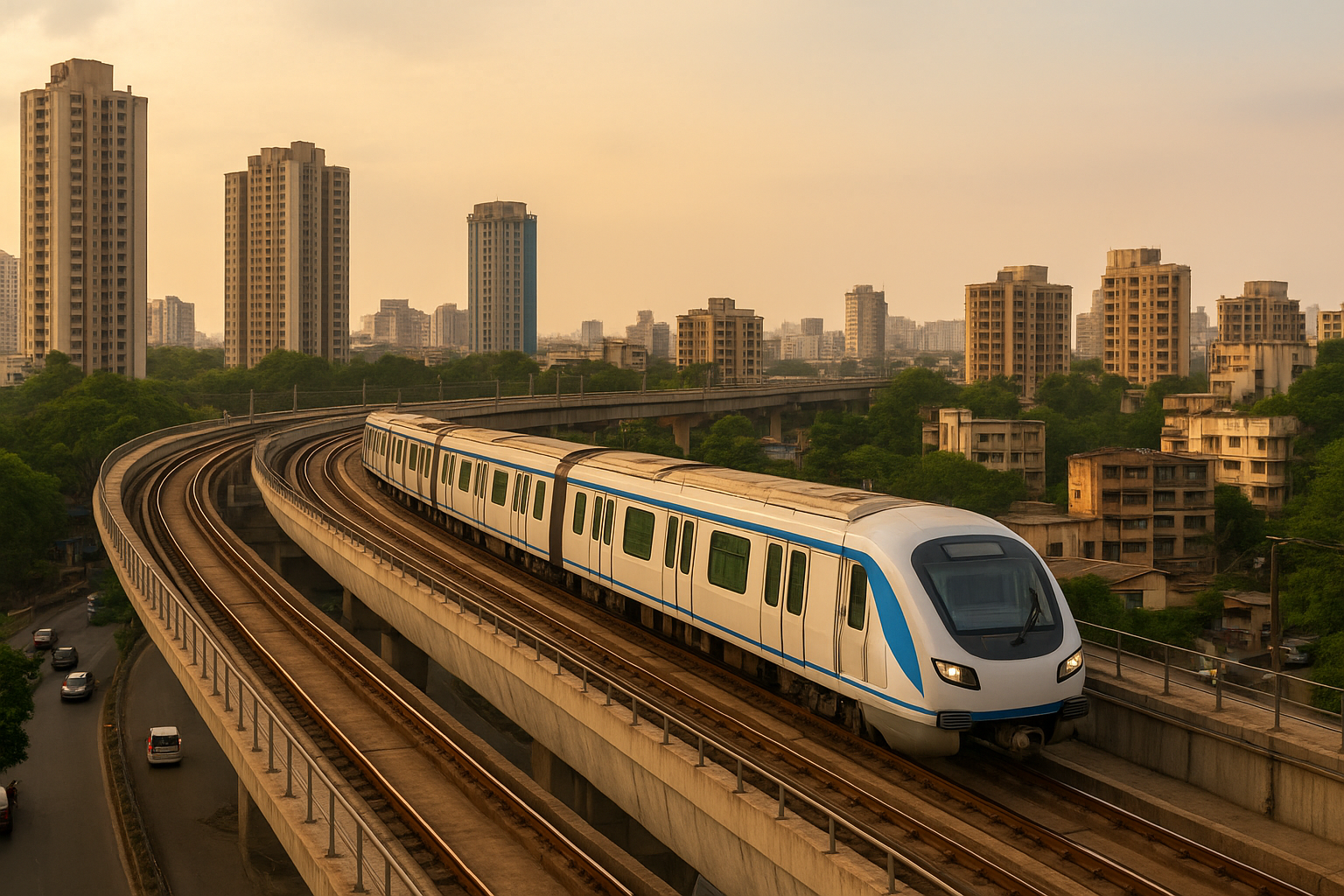
Thane is an important part of the Mumbai Metropolitan Region. Thane is a large area that is well-connected to other sections of Mumbai and Navi Mumbai via public transit, including state buses and local trains, as well as the projected Mumbai Metro lines. Internally, the city is well-connected by road, with cars, taxis, and public buses. Thane will soon be connected by a 29-kilometer internal ring metro, improving connectivity and providing an alternate sustainable choice for the city. In this guide, we will discuss the funding given, the stations, and the connectivity that this metro will provide. Read on.
What is the Thane Inner Ring Metro Project?
The Thane Internal Ring Metro, which will be built by Maharashtra Metro Rail Corporation Limited (Maha Metro), has been approved by the Union Cabinet chaired by Prime Minister Narendra Modi for August 2024. It is meant to form a loop that connects significant business and residential areas such as Manpada, Wagle Estate, and Thane Junction. This metro rail will be a mix of elevated and underground lines.
Quick facts of Thane Internal Ring Metro
|
Name of metro |
Thane Internal Ring Metro |
|
Length of Thane Internal Ring Metro |
29 km |
| Number of stations |
22 stations |
|
Start point |
Thane Junction |
| Endpoint |
Shivaji Chowk |
|
Construction type |
Elevated and underground corridor |
| Cost of the project |
Rs 12,200.10 crore |
|
Construction to be made in |
Public-private partnership (PPP) |
| To be made operational by |
2029 |
|
Metro type |
Rapid Transit Metro System |
|
Ridership expected in 2029 Ridership expected in 2035 Ridership expected in 2045 |
Around 6.47 lakh passengers lakh daily commuters Around 7.61 lakh passengers lakh daily commuters Around 8.72 lakh passengers are daily commuters |
|
Operator |
Maha Metro |
Thane Internal Ring Metro Map
Stations along the Thane Internal Ring Metro
|
Station |
Station type |
|
Thane Junction |
Underground |
|
New Thane |
Underground |
|
Raila Devi |
Elevated |
|
Wagle Circle |
Elevated |
|
Lokmanya Nagar Bus Depot |
Elevated |
|
Shivai Nagar |
Elevated |
|
Neelkanth Terminal |
Elevated |
|
Gandhi Nagar |
Elevated |
|
Kashinath Ghanekar Natyagruha |
Elevated |
|
Manpada |
Elevated |
|
Dongripada |
Elevated |
|
Vijay Nagari |
Elevated |
|
Waghbil |
Elevated |
|
Waterfront |
Elevated |
|
Patlipada |
Elevated |
|
Azad Nagar Bus Stop |
Elevated |
|
Manorma Nagar |
Elevated |
|
Kolshet Industrial Area |
Elevated |
|
Balkum Naka |
Elevated |
|
Balkumpada |
Elevated |
|
Rabodi |
Elevated |
| Shivaji Chowk |
Elevated |
The Thane Internal Ring Metro has 22 proposed stations. There will be a mixture of underground and elevated stops.
Thane Internal Ring Metro: Interchanges
The interchanges with Mumbai Metro are as follows:
With the Mumbai Metro Line 4 at Raila Devi and Dongripada
With Mumbai Metro Line 5 at Balkum Naka.
The following are interchanges with buses.
At Lokmanya Nagar Bus Depot.
The following are interchanges with the local train.
At Thane Junction and New Thane
What is the value of Thane’s Internal Ring Metro Project?
The project will cost approximately Rs 12,200.10 crore. The project will get equal equity from the Government of India (GOI) and the Government of Maharashtra (GoM), as well as some funding from bilateral agencies. Revenue will also be generated by selling station name rights and access rights to corporations, as well as through asset monetization and value capture finance.
Who will carry out the Thane Internal Ring Metro Project?
Maha Metro will carry out the project, as well as the civil, electromechanical, and other connected facilities, works, and assets. Maha Metro has already begun the pre-bid process and development of tender documentation. Contracts will be made available for bidding immediately.
What will be the timings for the Thane Internal Ring Metro?
The timetables for the Thane Internal Ring Metro will be determined once it is completed and operational. However, the usual operating hours are from 6 a.m. to 11 p.m. every day, and this metro will mainly follow the same schedule to keep up with other metro lines and public transportation.
What will be the fare for the Thane Internal Ring Metro?
The Thane Internal Ring Metro fare will be determined closer to the operating date. This will be determined based on the distance travelled in km. In general, the rate for a single ride between 0 and 3 km is Rs 10, Rs 20 for a single journey between 3 and 12 km, and Rs 30 for a single journey from 12 to 18 km.
People can purchase tickets for the operational metro lines at ticket counters, by scanning QR codes, or via WhatsApp. This will be extended to the Thane Internal Ring Metro once it begins operating.
What facilities would be available at Thane Internal Ring Metro stations?
The Thane Internal Ring Metro includes the following facilities:
Elevators
Escalators
Wheelchairs
Information centre
Ticketing counters
Washrooms
Staircase
Ramps
First aid
Water coolers
Convenience stores
Emergency exits
Bank ATM
Benefits of Thane’s Internal Ring Metro
This link is intended to provide a sustainable and efficient form of transportation.
It will benefit Thane City economically.
It will improve traffic flow and reduce greenhouse gas emissions.
It will shorten travel time and reduce noise and traffic pollution.
The Thane Internal Ring Metro Project’s Impact on Thane’s Real Estate Market
Thane is a highly desirable real estate market with a number of reputable developers. This neighbourhood has an intriguing mix of real estate offerings, ranging from old chawls to houses, studio flats, 1 BHK, 1.5 BHK in standalone structures, and 2, 2.5 BHK, 3, 4, and 5 BHK in standalone and gated communities. With this metro connecting Thane inside, residential neighbourhoods will benefit from increased connectivity that is also cost-effective. Furthermore, Thane will be connected to major districts in Mumbai and Navi Mumbai by this internal metro project, making everyday commutes easier and more comfortable.